


Menopause and the Skin: What Estrogen Does for Thickness, Elasticity, and Hydration
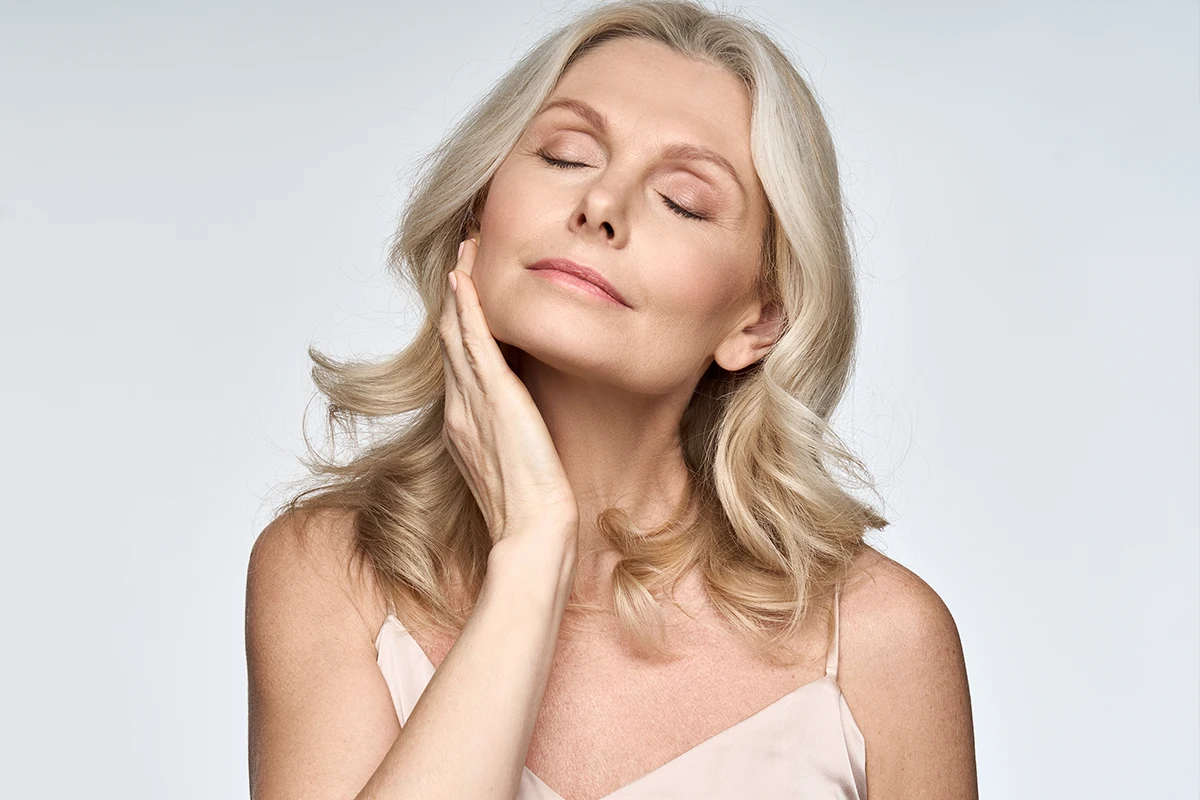
Patients who come to Harmon Facial Plastic Surgery are frequently concerned about sudden changes to their face after menopause. They feel their facial skin has become thinner, more wrinkled, and sagging within a year or two of experiencing their first symptoms, which are usually hot flashes. The negative effects on someone’s self-image and, therefore, self-confidence with these changes are profound, not the least of which because – at a median age of onset of 51 – women can now expect to live more than one-third of their lifetimes after menopause (1, 2, 3). In effect, they are expected to live decades of their lives post-menopause experiencing a host of difficult symptoms including, but not limited to, degradation of their skin quality.
Menopause Symptoms are the Result of a Cessation of Estrogen Production by the Ovaries
What changes occur after menopause and why? And could addressing these changes prevent or even reverse the rapid skin aging associated with menopause?
Questions about skin health post-menopause are often dismissed by a medical community that:
- Understandably, is more concerned with other, more medically serious, non-aesthetic symptoms.
- Questions whether the benefits of treating the underlying cause of menopause outweigh the risks.
The primary cause of menopausal symptoms, including skin aging, is a decline and eventual cessation of the production of estrogen by the ovaries (4). Other factors involved in skin aging include (5):
- Genetics
- Lifestyle (e.g. chronic unprotected sun exposure, smoking history, alcohol history, diet)
The primary source of estrogen production in the body after menopause is in the body’s adipose (fat) but at much lower levels (6). As a result, women live with a significantly reduced level of circulating estrogen after menopause.
The typical symptoms patients present to their physician with when they experience menopause are vasomotor i.e. nervous system symptoms such as hot flashes and sleep disturbances (7). Vasomotor symptoms usually last for approximately four (4) to five (5) years after the onset of menopause. However, there are many other symptoms of menopause that extend far beyond this timeframe. For example, a serious consequence of menopause is a steady reduction in bone mineral density that can lead to osteopenia or even osteoporosis (3).
Both research and the experience of physicians suggest that skin aging is more closely associated with time after menopause than actual chronological age. In other words, a forty-five (45) year old female five (5) years out from the beginning of early-onset menopause may experience more severe skin changes than a fifty-five (55) year old female who has not yet experienced menopause, all else being equal (4).
Key to our understanding of how menopause and the resultant significant reduction in estrogen affects the skin was the discovery that it contains estrogen receptors. Moreover, these receptors are particularly concentrated in the face when compared to skin in other parts of the body (6). To make matters worse, the concentration of estrogen receptors on the skin steadily declines after menopause, thereby reducing the ability of estrogen to perform its important signaling functions.
Menopause Leads to Thinner, Looser, and Dryer Skin
The post-menopausal state of estrogen deficiency leads to several rapid, time-dependent changes to the skin that lead to a breakdown in the skin’s “architecture”:
- The skin thins due to a decrease in the amount of collagen and the development of more disorganized collagen in the skin (1, 2, 5, 6).
- The skin becomes less elastic and, therefore, looser due to due to a decrease in the amount of a structural protein in the skin called elastin (1, 3). Loss of elasticity due to the loss of elastin is the most difficult thing to restore/improve when treating the skin.
- The skin becomes dryer due to a reduction in the number of water-loving molecules in the skin called glycosaminoglycans (GAG) (e.g. hyaluronic acid) and a weakening of the skin water barrier due to decrease in the sebum produced in the skin as well as a breakdown in the lipid (fat) content and composition of the skin. Dry skin is the most common skin complaint made by those experiencing menopause (2, 5).
- The skin does not heal as well, in part due to a decrease in the rate and extent of formation of new blood vessels i.e. angiogenesis at injured sites on the body (1, 2, 6).
The effect is thinner, looser, less stretchy, more wrinkled, dryer skin that may not heal as well or as quickly.
Hormone Replacement Therapy (HRT) as Treatment for the Symptoms of Menopause
How can skin changes be treated and/or prevented from occurring? This article will not weigh in on whether a specific treatment for menopause is generally appropriate or not. Specialized physician experts in menopausal health are best qualified to determine the most appropriate treatment for women experiencing menopause. There are complex tradeoffs associated with increasing the levels of estrogen in the body. In addition, aesthetic changes to the skin are probably the least medically important change associated with menopause. As a result, treatment for menopause is not indicated specifically to treat skin symptoms. Hormone Replacement Therapy (HRT) therapy for symptoms of menopause is not the area of expertise of a facial plastic surgeon. Therefore, advice should be sought elsewhere for it.
HRT has been used to replace lost estrogen for many decades in post-menopausal women. However, the prevalence of its use has waxed and waned over the decades. For example, the use of HRT decreased dramatically in the early 2000s after concerns about an increased risk of breast cancer with HRT use were expressed by investigators in the 2002 Women’s Health Initiative (WHI) Randomized Controlled Trial. This study led to an FDA Black Box Warning to be placed on HRT. This warning was recently removed due to additional evidence suggesting the potential benefits outweigh the risks when given early enough after the onset of menopause and in appropriately selected patients (3, 8).
The reported benefit of estrogen replacement on the skin was a serendipitous discovery, like when an ophthalmologist discovered the aesthetic potential of botulinum toxin (e.g. Botox®) while treating eye muscle disorders (9). This observation led to a series of questions about the effects of estrogen replacement on the skin:
- Was the observation of a decline in skin quality associated with menopause and an observation of improvement in the skin on HRT associative or causative? In other words, do the estrogen levels in the body directly affect the skin or is there something else? The answer, based on the available research, is that estrogen deprivation likely greatly contributes, along with age, genetics, and lifestyle factors.
- Can estrogen reverse the effects of skin changes after menopause, or does estrogen simply slow the progression of skin changes (2)? Estrogen is likely better at preventing changes than reversing changes. Also, the effects of smoking and extensive sun exposure may prevent estrogen from being beneficial to the skin in the first place.
- Does estrogen therapy in HRT need to be systemic (e.g. taken by mouth) or can it be topical, applied directly to the treatment site, thereby avoiding an increase in estrogen levels in the blood? Both are likely effective, though a treatment utilizing estrogen or an estrogen-like compound applied directly to the site of concern that minimizes changes in the blood levels of estrogen would likely be ideal. An FDA-approved treatment does not yet exist. Also, there is concern about what the adverse effects of applying estrogen directly to facial skin could be.
- What is the most effective dose and time course for treatment with estrogen? It is likely that higher doses for longer are more effective though this is not clear.
All these questions have been studied, though no definitive, consensus-driven treatment using estrogen is available for the skin. Until such a treatment is available, there are multiple available treatment options for the aesthetic consequences of menopause that do not involve the use of HRT. This may because studies evaluating the above questions are not in universal agreement about the answers (10)
Facial Plastic Surgery Procedures Can Treat Post-Menopause Changes to the Face and Neck
There are many surgical and non-surgical treatment options for facial aging. Loose, hanging facial skin is generally associated with drooping of the deeper structures of the face that leads to larger volume shifts in the face. The best approach to address these three dimensional changes to the face is with a deep plane facelift and deep neck lift. It is important to discuss the use of HRT in surgical patients because the use of HRT does increase the risk of a post-operative blood clot, though to a highly variable extent depending on whether estrogen and progesterone are being taken together and whether the medications are taken by mouth or administered transdermal through a patch. Laser resurfacing procedures, including a fractional ablative CO2 laser, can be used to treat fine lines and wrinkles and some of the discoloration (dyschromias) and textural abnormalities of the skin. Laser resurfacing works by removing pigmented cells that cause discoloration and create better organized collagen in the skin. Laser resurfacing is often combined with regenerative medicine treatments such as a mixture of nano-fat and platelet rich plasma (PRP), which are injected into the skin to enhance healing and the effectiveness of the laser by helping to thicken the skin.
For more on timing and what to expect, see our related post on facelift prior to menopause.
Skincare is Essential to Start Prior to the Onset of Menopause
Both surgical and non-surgical treatments are available regardless of chronological age. This means that treatments are available earlier in patients experiencing more rapid, early to their skin post-menopause.
Skincare, however, should start well before menopause, prior to any changes to the skin that may or may not be improved with HRT. Preventative topical skincare is essential to minimize the effects of skin aging. It starts with sun protection. The most important topical treatment for the skin is sunscreen, preferably a tinted mineral sunscreen with an SPF of 30 or greater. The second most important product is a moisturizer. The third most important product is a retinol or prescription retinoid (tretinoin) in those patients who have skin features that these medications may help address.
Dr. Jeffrey Harmon is a Facial Plastic Surgeon and Expert in Treating Facial Aging Post-Menopause
Skincare should be started long before menopause. Determining the appropriate surgical and non-surgical treatments for skin aging depends on a thorough consultation with a qualified surgeon who can discuss your aesthetic concerns and create a tailored treatment plan. This is important regardless of whether the patient has been placed HRT therapy or not.
Dr. Jeffrey Harmon is a facial plastic surgeon who is fellowship-trained through the American Academy of Facial Plastic and Reconstructive Surgery (AAFPRS) and board-certified through both the American Board of Otolaryngology – Head and Neck Surgery (ABO-HNS) and the American Board of Facial Plastic and Reconstructive Surgery (ABFPRS). Dr. Harmon is eminently qualified to care for your face as he is an experienced specialist and expert in the surgical and non-surgical care of the face and neck.
References
- Brincat MP, Baron YM, Galea R. Estrogens and the skin. Climacteric. 2005 Jun;8(2):110-23.
- Shu YY, Maibach HI. Estrogen and skin: therapeutic options. Am J Clin Dermatol. 2011 Oct 1;12(5):297-311.
- Zouboulis CC, Blume-Peytavi U, Kosmadaki M, Roó E, Vexiau-Robert D, Kerob D, Goldstein SR. Skin, hair and beyond: the impact of menopause. Climacteric. 2022 Oct;25(5):434-442.
- Reus TL, Brohem CA, Schuck DC, Lorencini M. Revisiting the effects of menopause on the skin: Functional changes, clinical studies, in vitro models and therapeutic alternatives. Mech Ageing Dev. 2020 Jan;185:111193.
- Viscomi B, Muniz M, Sattler S. Managing Menopausal Skin Changes: A Narrative Review of Skin Quality Changes, Their Aesthetic Impact, and the Actual Role of Hormone Replacement Therapy in Improvement. J Cosmet Dermatol. 2025 Sep;24 Suppl 4(Suppl 4):e70393.
- Hall G, Phillips TJ. Estrogen and skin: the effects of estrogen, menopause, and hormone replacement therapy on the skin. J Am Acad Dermatol. 2005 Oct;53(4):555-68.
- Monteleone P, Mascagni G, Giannini A, Genazzani AR, Simoncini T. Symptoms of menopause - global prevalence, physiology and implications. Nat Rev Endocrinol. 2018 Apr;14(4):199-215.
- Roster K, Fleshner L, Karatas TB, Ecanow A, Sayegh A, Farabi B, Marmon S. Menopause and Common Dermatoses: A Systematic Review. Am J Clin Dermatol. 2026 Jan;27(1):67-84.
- Archer DF. Postmenopausal skin and estrogen. Gynecol Endocrinol. 2012 Oct;28 Suppl 2:2-6.
- Miller VM, Naftolin F, Asthana S, Black DM, Brinton EA, Budoff MJ, Cedars MI, Dowling NM, Gleason CE, Hodis HN, Jayachandran M, Kantarci K, Lobo RA, Manson JE, Pal L, Santoro NF, Taylor HS, Harman SM. The Kronos Early Estrogen Prevention Study (KEEPS): what have we learned? Menopause. 2019 Sep;26(9):1071-1084.
Disclaimer
This blog post is for educational purposes only and does not constitute direct medical advice. It is essential that you have a consultation with a qualified medical provider prior to considering any treatment. This will allow you the opportunity to discuss any potential benefits, risks, and alternatives to the treatment.
Book Your Consultation
Take the first step toward enhancing your natural beauty by scheduling a personalized consultation with Dr. Jeffrey Harmon. As a double board-certified facial plastic surgeon trained by the pioneer of the extended deep plane facelift, Dr. Harmon offers expert guidance and care. Whether you're considering surgical or non-surgical options, our team is here to support your journey to renewed confidence.